
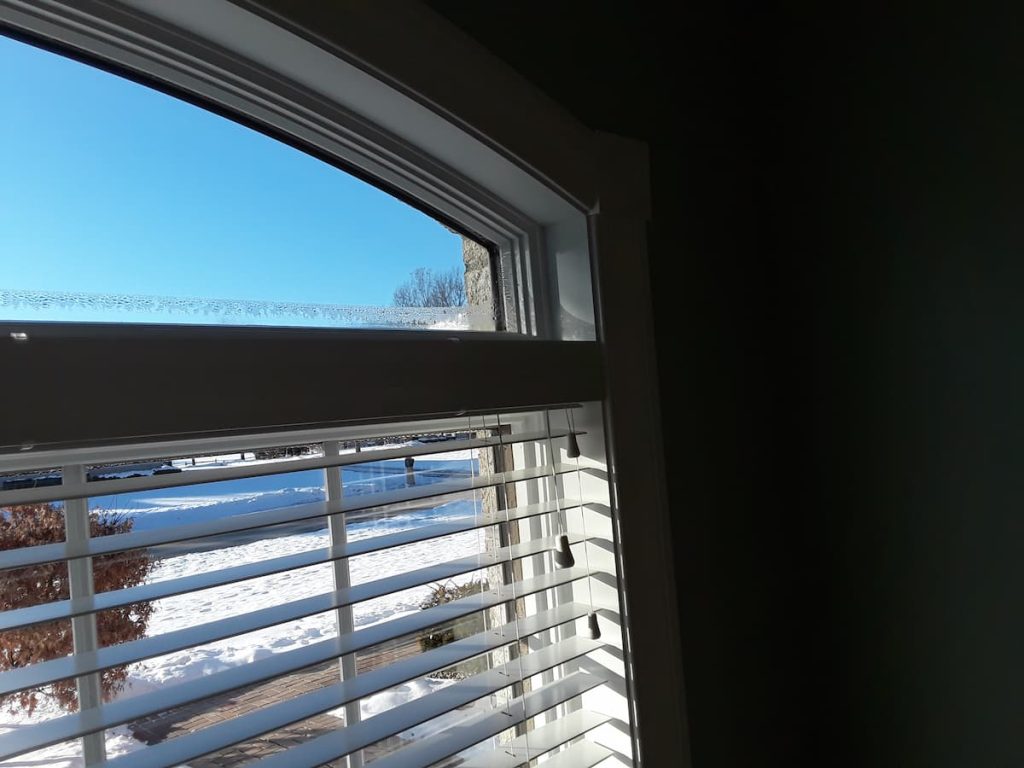
If you’ve got window condensation forming during Wisconsin winters, you’re not alone — and you’ve probably already heard the most common suggestion: replace your windows. Before you make that investment, there’s something worth understanding. In most cases, your windows aren’t the problem. They’re just where the problem shows up.
What’s Actually Causing Window Condensation
Condensation forms when a surface reaches what’s called the dew point — the temperature at which air can no longer hold its moisture and water begins to form on whatever surface it touches first.
Here’s a concrete example. If your thermostat is set to 70°F and your indoor humidity is 50% — right in the middle of the generally accepted comfort range — your indoor dew point temperature is approximately 50.5°F. That means any surface at or below 50.5°F will have moisture on it.
Now consider your windows. A standard double-pane window has roughly three quarters of an inch between the inside pane of glass and the outside air. When it’s 10 or 20 degrees outside, it doesn’t take long for that inside pane to drop well below 50°F. The glass isn’t failing — it’s just doing what glass does. Glass is a conductor, and conductors transfer temperature. Even the best thermopane window on the market will get cold when it’s cold outside.
Your windows are showing you where the dew point is being reached. They’re not causing it.
What Is Causing It
The more important question is why your indoor humidity is high enough that condensation is forming in the first place. There are several common causes — and windows are rarely among them.
Too much moisture being generated indoors.
Every person in your home breathes, cooks, showers, and goes about daily life generating moisture. In a home that doesn’t have adequate fresh air exchange, that moisture accumulates. This is one of the most common causes of winter condensation we find.
A humidifier set too high for the outdoor temperature.
This surprises many homeowners, but the right indoor humidity level isn’t fixed — it needs to change with the outdoor temperature. The colder it is outside, the lower your indoor humidity needs to be to prevent condensation. The Fenestration and Glazing Industry Alliance publishes a chart showing recommended maximum indoor humidity at various outdoor temperatures — it’s a useful reference for any Wisconsin homeowner managing a humidifier. As outdoor temperatures drop, indoor humidity should be lowered accordingly to reduce the likelihood of condensation.
A home that’s too tight without adequate ventilation.
Here’s something that surprises people: over the last 30 to 40 years, homes have been built progressively tighter. Modern windows seal better than older wood-on-wood windows that wore down over time. High efficiency furnaces don’t use indoor air for combustion the way older systems did, so less air leaks out through the heating system. The result is that moisture generated inside your home has fewer places to go — and stays in your living space instead.
Older homes often needed humidifiers to replace moisture that was constantly escaping. Many modern homes need the opposite — a dehumidifier, or a ventilation system designed to exchange stale moist air for fresh dry air in a controlled way. Humidity management in today’s homes is a different challenge than it was a generation ago, and the conventional wisdom hasn’t always caught up.
An open crawlspace.
Less common in the Green Bay metro area but worth mentioning — an unsealed crawlspace can introduce significant ground moisture into a home’s air supply, contributing to elevated humidity levels throughout the house.
What About “Drafty” Windows?
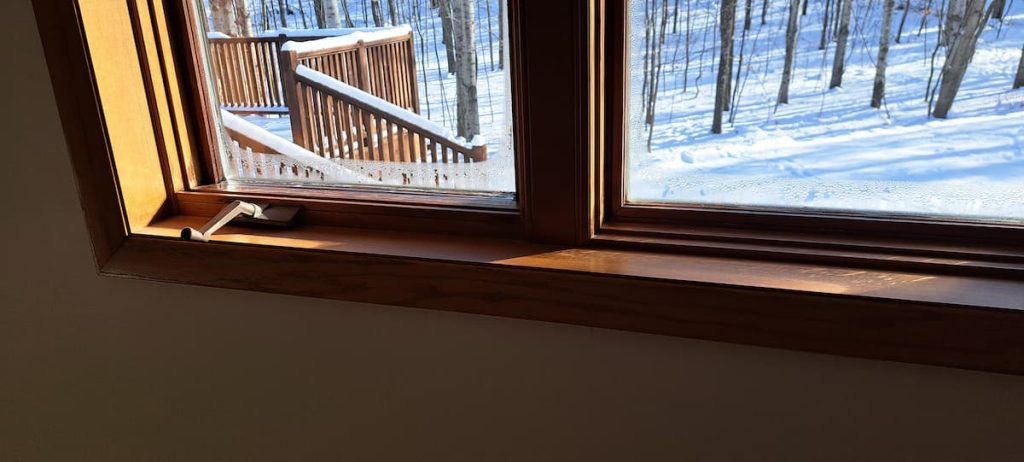
Many homeowners associate condensation with drafty windows and assume new windows will solve both problems at once. The draft explanation is worth examining more carefully.
When you feel cold air near a window, the instinct is to assume air is pushing in from outside. What’s more likely happening is that warm air is escaping your home through gaps and leaks elsewhere — in your attic, around light fixtures, through wall penetrations — and cold air is being drawn toward the windows to replace it. The window feels drafty because it’s at the end of that air movement, not the cause of it.
We hear this regularly from customers after we’ve air sealed their attics: the windows that felt drafty before suddenly feel fine — and we never touched the windows. The air movement driving the draft was coming from somewhere else entirely.
New windows may incidentally reduce some drafts by tightening the seal between the window frame and the wall framing. But that’s a secondary effect, not a solution to the underlying air movement problem. And it comes at a cost that rarely matches the benefit compared to what targeted air sealing can accomplish for a fraction of the price.
A Note on Window Frame Construction
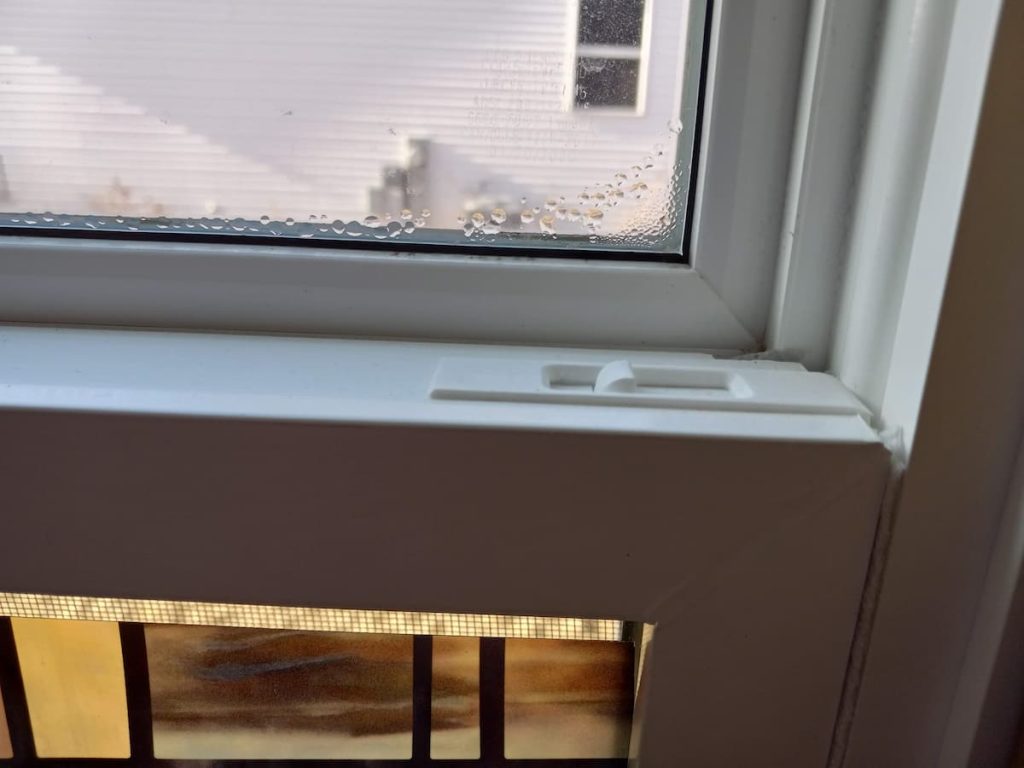
Here’s something worth knowing if you have newer non-wood windows — vinyl, fiberglass, or aluminum. These frames are built from hollow tubing profiles, which insulate well along the straight sections. But at the corners, the tubes need a solid structural connection all the way through. That solid corner conducts temperature more directly than the hollow sections do.
During extreme cold, this means the corners of the frame can be significantly colder than the rest of the window — and condensation or frost shows up specifically there, even on well-performing windows. It’s not a defect. It’s physics. And the solution is still humidity management, not new windows.
What the Fix Actually Looks Like
Solving a condensation problem almost always involves some combination of three things: reducing moisture sources, improving fresh air exchange, and air sealing to control where air moves through your home.
The right balance depends on your specific home — its age, construction, how tight it already is, and what’s generating moisture inside it. According to the Center for Energy and Environment in Minnesota, when energy auditors visit homes in winter and observe condensation buildup, the solution generally revolves around properly air sealing and insulating the home. That’s consistent with what we find too.
Air sealing addresses the underlying air movement driving both the condensation and the draft sensation near windows. Proper ventilation gives moisture a controlled pathway out of the house. And in some cases — particularly in newer, tighter homes — a dehumidifier or heat recovery ventilator gives you active control over humidity year-round.
What the fix almost never involves is new windows. If you’re seeing condensation on your current windows, new windows will likely show you the same condensation — because the humidity causing it will still be there.
This Is Also an Air Quality Issue
Condensation on your windows is a visible sign of elevated indoor humidity. But humidity affects more than your windows — it affects the air your family breathes every day. Elevated moisture levels create conditions favorable to mold growth, dust mites, and other biological pollutants. Managing humidity isn’t just about protecting your windows and walls — it’s about maintaining a healthy indoor environment.
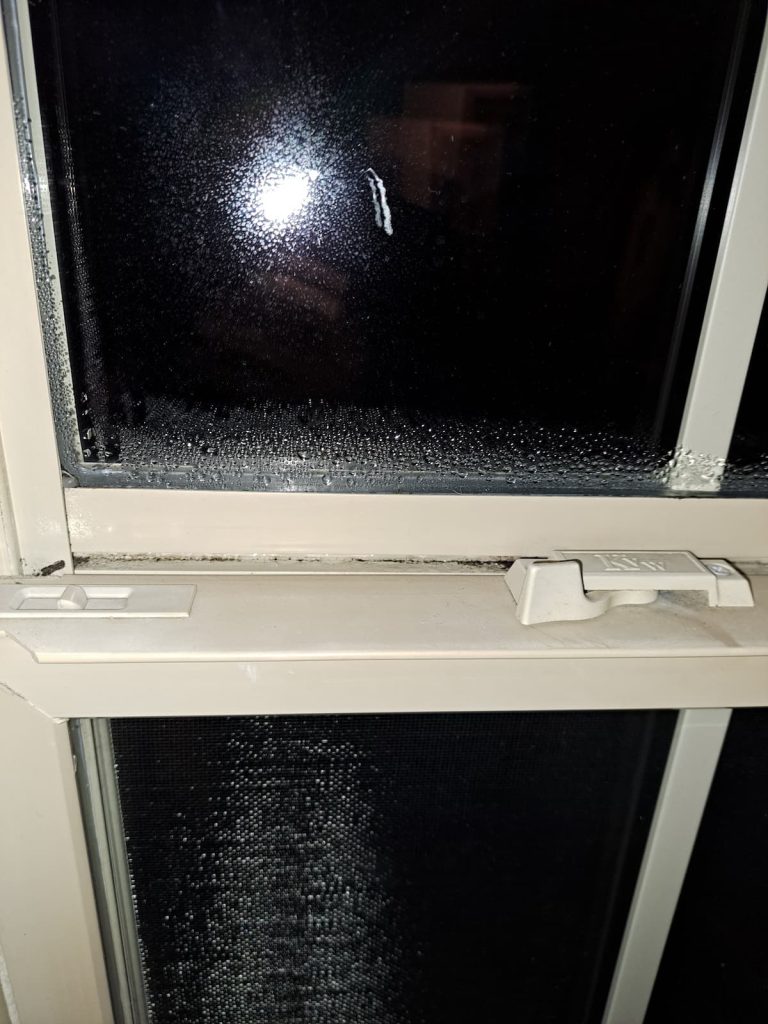
This is one of the reasons we’ve been expanding into indoor air quality services. The same whole-house approach that solves comfort and moisture problems is the foundation for a healthier home.
Contact us here or fill out our estimate request form to start the conversation. If you’re seeing condensation on your windows this winter — or you want to understand what’s driving the humidity in your home before it becomes a bigger problem — we’d be glad to take a look.

- Is the Air in Your Home Making You Sick? What Indoor Air Quality Really Means - April 30, 2026
- How Do Focus on Energy Rebates Work — and Do You Qualify? - April 26, 2026
- Why Are My Windows Wet — and Will New Windows Fix It? - April 16, 2026