Dan Guse, Author at Home Energy Solutions of Wisconsin

A Holistic Approach to Energy Improvements. Not Just Insulation.


Why Are My Windows Wet — and Will New Windows Fix It?

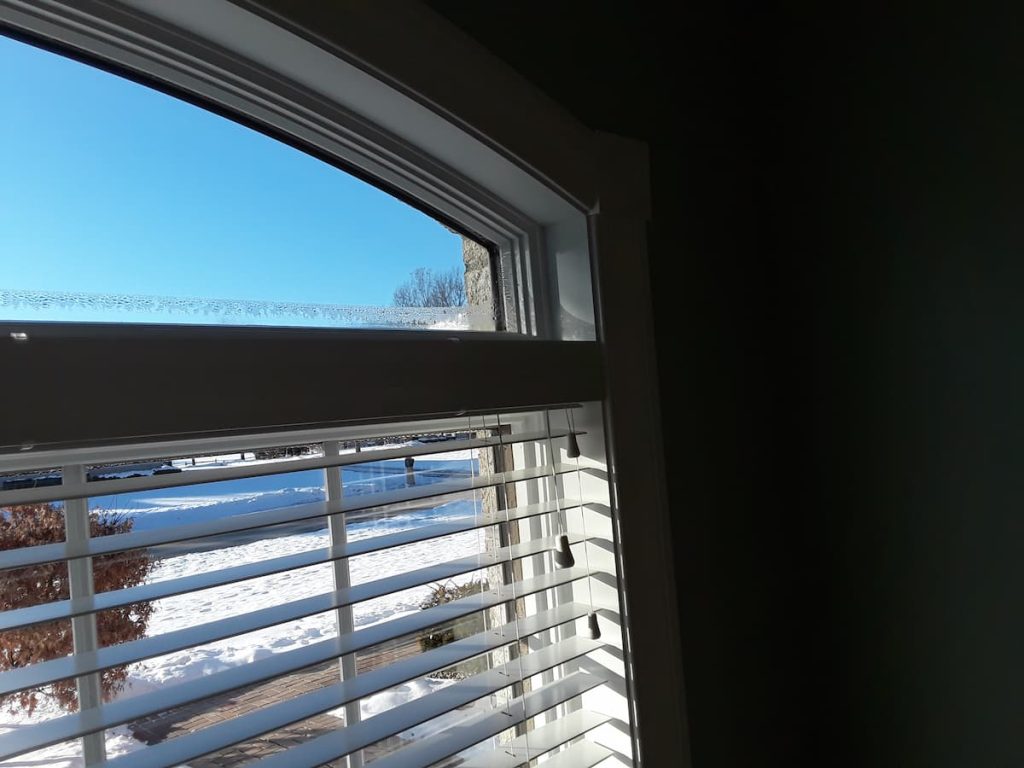
Window condensation forming along the bottom of a wood frame window during a Wisconsin winter
Condensation forming along the bottom of a window during a Wisconsin winter. The window isn’t the problem — it’s showing you where the dew point is being reached.

If you’ve got window condensation forming during Wisconsin winters, you’re not alone — and you’ve probably already heard the most common suggestion: replace your windows. Before you make that investment, there’s something worth understanding. In most cases, your windows aren’t the problem. They’re just where the problem shows up.


What’s Actually Causing Window Condensation

Condensation forms when a surface reaches what’s called the dew point — the temperature at which air can no longer hold its moisture and water begins to form on whatever surface it touches first.

Here’s a concrete example. If your thermostat is set to 70°F and your indoor humidity is 50% — right in the middle of the generally accepted comfort range — your indoor dew point temperature is approximately 50.5°F. That means any surface at or below 50.5°F will have moisture on it.

Now consider your windows. A standard double-pane window has roughly three quarters of an inch between the inside pane of glass and the outside air. When it’s 10 or 20 degrees outside, it doesn’t take long for that inside pane to drop well below 50°F. The glass isn’t failing — it’s just doing what glass does. Glass is a conductor, and conductors transfer temperature. Even the best thermopane window on the market will get cold when it’s cold outside.

Your windows are showing you where the dew point is being reached. They’re not causing it.


What Is Causing It

The more important question is why your indoor humidity is high enough that condensation is forming in the first place. There are several common causes — and windows are rarely among them.

Too much moisture being generated indoors.

Every person in your home breathes, cooks, showers, and goes about daily life generating moisture. In a home that doesn’t have adequate fresh air exchange, that moisture accumulates. This is one of the most common causes of winter condensation we find.

A humidifier set too high for the outdoor temperature.

This surprises many homeowners, but the right indoor humidity level isn’t fixed — it needs to change with the outdoor temperature. The colder it is outside, the lower your indoor humidity needs to be to prevent condensation. The Fenestration and Glazing Industry Alliance publishes a chart showing recommended maximum indoor humidity at various outdoor temperatures — it’s a useful reference for any Wisconsin homeowner managing a humidifier. As outdoor temperatures drop, indoor humidity should be lowered accordingly to reduce the likelihood of condensation.

A home that’s too tight without adequate ventilation.

Here’s something that surprises people: over the last 30 to 40 years, homes have been built progressively tighter. Modern windows seal better than older wood-on-wood windows that wore down over time. High efficiency furnaces don’t use indoor air for combustion the way older systems did, so less air leaks out through the heating system. The result is that moisture generated inside your home has fewer places to go — and stays in your living space instead.

Older homes often needed humidifiers to replace moisture that was constantly escaping. Many modern homes need the opposite — a dehumidifier, or a ventilation system designed to exchange stale moist air for fresh dry air in a controlled way. Humidity management in today’s homes is a different challenge than it was a generation ago, and the conventional wisdom hasn’t always caught up.

An open crawlspace.

Less common in the Green Bay metro area but worth mentioning — an unsealed crawlspace can introduce significant ground moisture into a home’s air supply, contributing to elevated humidity levels throughout the house.


What About “Drafty” Windows?
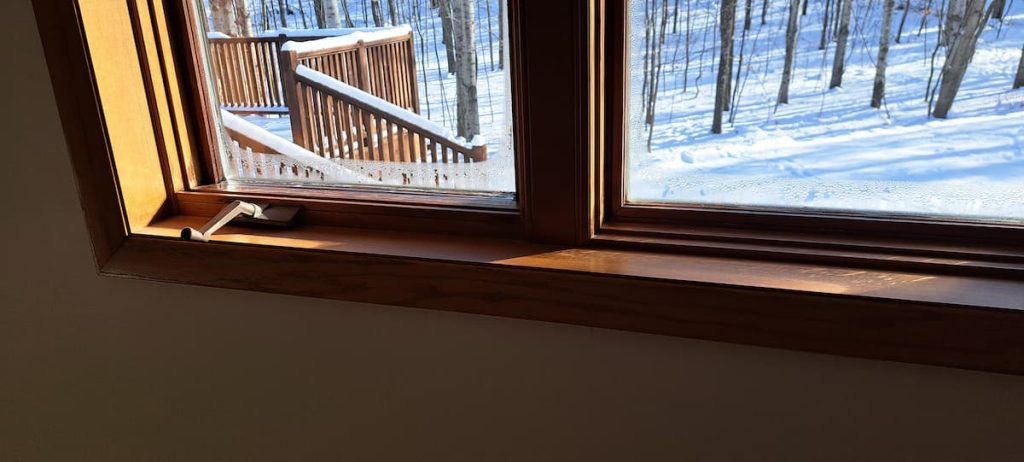
Winter window condensation on wood frame windows with snowy scene outside — condensation affects both wood and non-wood windows when indoor humidity is too high
Wood frame windows with condensation — a reminder that this isn’t a window quality issue. Both wood and non-wood windows show condensation when indoor humidity is too high for the outdoor temperature.

Many homeowners associate condensation with drafty windows and assume new windows will solve both problems at once. The draft explanation is worth examining more carefully.

When you feel cold air near a window, the instinct is to assume air is pushing in from outside. What’s more likely happening is that warm air is escaping your home through gaps and leaks elsewhere — in your attic, around light fixtures, through wall penetrations — and cold air is being drawn toward the windows to replace it. The window feels drafty because it’s at the end of that air movement, not the cause of it.

We hear this regularly from customers after we’ve air sealed their attics: the windows that felt drafty before suddenly feel fine — and we never touched the windows. The air movement driving the draft was coming from somewhere else entirely.

New windows may incidentally reduce some drafts by tightening the seal between the window frame and the wall framing. But that’s a secondary effect, not a solution to the underlying air movement problem. And it comes at a cost that rarely matches the benefit compared to what targeted air sealing can accomplish for a fraction of the price.


A Note on Window Frame Construction

Here’s something worth knowing if you have newer non-wood windows — vinyl, fiberglass, or aluminum. These frames are built from hollow tubing profiles, which insulate well along the straight sections. But at the corners, the tubes need a solid structural connection all the way through. That solid corner conducts temperature more directly than the hollow sections do.

During extreme cold, this means the corners of the frame can be significantly colder than the rest of the window — and condensation or frost shows up specifically there, even on well-performing windows. It’s not a defect. It’s physics. And the solution is still humidity management, not new windows.
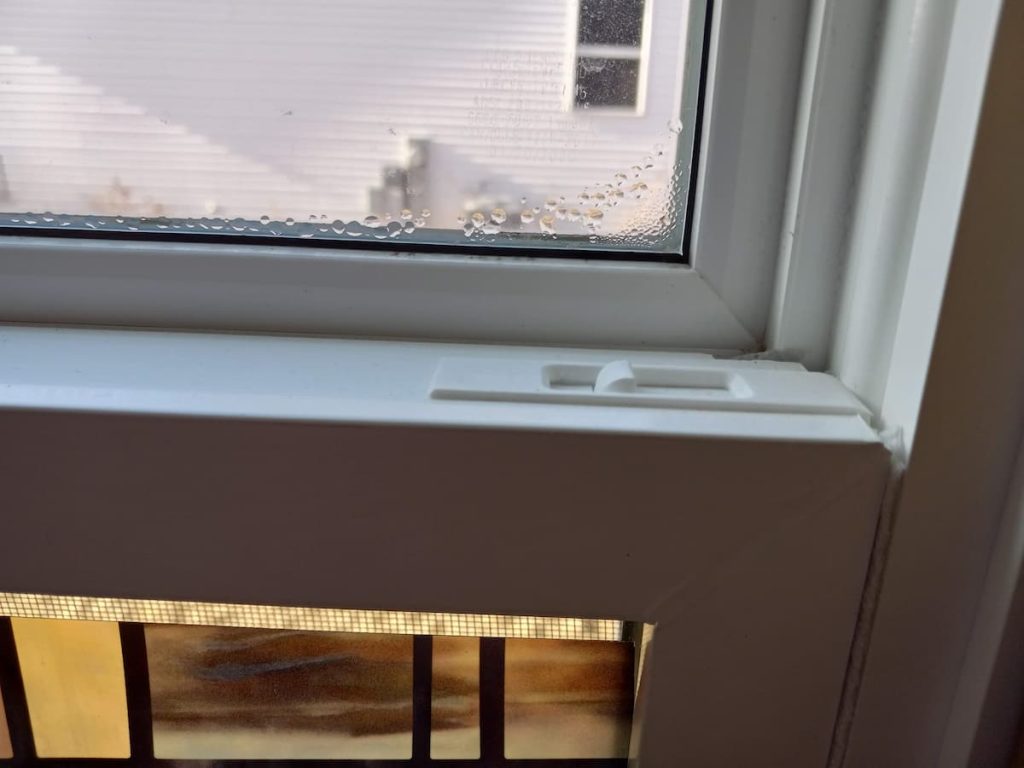
Condensation concentrated at the corner of a vinyl window frame during Wisconsin winter — the solid structural corner conducts cold more directly than the hollow frame sections
Condensation concentrated at the corner and bottom edge of a vinyl window frame — exactly where the solid structural corner connection creates a colder surface than the rest of the frame.

What the Fix Actually Looks Like

Solving a condensation problem almost always involves some combination of three things: reducing moisture sources, improving fresh air exchange, and air sealing to control where air moves through your home.

The right balance depends on your specific home — its age, construction, how tight it already is, and what’s generating moisture inside it. According to the Center for Energy and Environment in Minnesota, when energy auditors visit homes in winter and observe condensation buildup, the solution generally revolves around properly air sealing and insulating the home. That’s consistent with what we find too.

Air sealing addresses the underlying air movement driving both the condensation and the draft sensation near windows. Proper ventilation gives moisture a controlled pathway out of the house. And in some cases — particularly in newer, tighter homes — a dehumidifier or heat recovery ventilator gives you active control over humidity year-round.

What the fix almost never involves is new windows. If you’re seeing condensation on your current windows, new windows will likely show you the same condensation — because the humidity causing it will still be there.


This Is Also an Air Quality Issue

Condensation on your windows is a visible sign of elevated indoor humidity. But humidity affects more than your windows — it affects the air your family breathes every day. Elevated moisture levels create conditions favorable to mold growth, dust mites, and other biological pollutants. Managing humidity isn’t just about protecting your windows and walls — it’s about maintaining a healthy indoor environment.
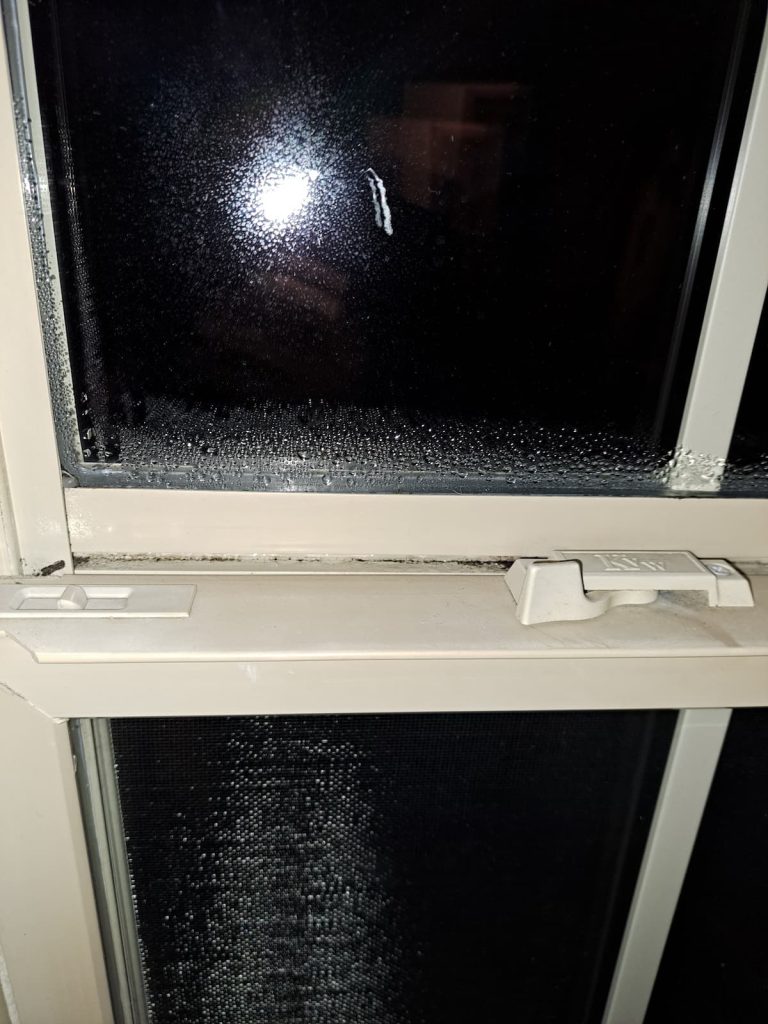
Heavy condensation and black residue on a vinyl window frame — long-term moisture damage from elevated indoor humidity in a Wisconsin home
Long-term condensation leaves more than just water marks. The black residue accumulating at this window frame is a sign that moisture has been creating conditions for biological growth — an indoor air quality concern, not just a cosmetic one.

This is one of the reasons we’ve been expanding into indoor air quality services. The same whole-house approach that solves comfort and moisture problems is the foundation for a healthier home.


Contact us here or fill out our estimate request form to start the conversation. If you’re seeing condensation on your windows this winter — or you want to understand what’s driving the humidity in your home before it becomes a bigger problem — we’d be glad to take a look.
Three Questions to Ask Before Hiring an Insulation Contractor

Most homeowners shopping for insulation are focused on price. That’s understandable — but it’s also why so many insulation jobs don’t deliver the comfort and efficiency improvements people were hoping for. The difference between a contractor who installs insulation and one who actually solves your home’s comfort and efficiency problems comes down to a few key questions. Here’s what to ask — and what the answers should tell you.


What Is Building Science — and Why Does It Matter?

Most people have never heard the term “building science.” That’s not surprising — even many professionals in the trades either haven’t encountered it or don’t take it seriously. But building science is a real and well-established field of knowledge that explains how the components of a home — insulation, air sealing, ventilation, heating and cooling systems, and moisture management — work together as a system.

Understanding building science is what separates a home performance contractor from someone who simply installs insulation. It’s the difference between treating a symptom and solving the actual problem. And it’s the reason the questions below matter.


Question 1 to Ask Your Insulation Contractor: Do You Do the Work Yourselves?

This question gets at accountability — and it’s one most homeowners never think to ask.

When the company you hire does its own work with its own trained employees, there’s a direct line of accountability from the person who assessed your home to the people doing the work to the result you experience. If something isn’t right, there’s one phone call to make and one company responsible for fixing it.

When work is subcontracted, that line gets complicated. The company you hired and the crew actually doing the work may have different standards, different training, and different priorities. The person who sold you the job may never set foot in your attic. And when something isn’t right — as it sometimes isn’t — the accountability conversation gets complicated quickly.

At Home Energy Solutions, every job is done by our own trained employees. We don’t subcontract. The people doing the work in your home are the same people accountable for the result.


Question 2 to Ask Your Insulation Contractor: How Do I Know This Will Solve My Problem?

This is the science question — and the answer reveals whether a contractor is guessing or diagnosing.

A commodity insulation contractor will typically do a visual inspection, look at your existing insulation levels, and recommend adding more. That’s not nothing — but it’s also not a diagnosis. It doesn’t tell you how much energy your home is actually losing, where it’s going, or whether insulation is even the primary issue.

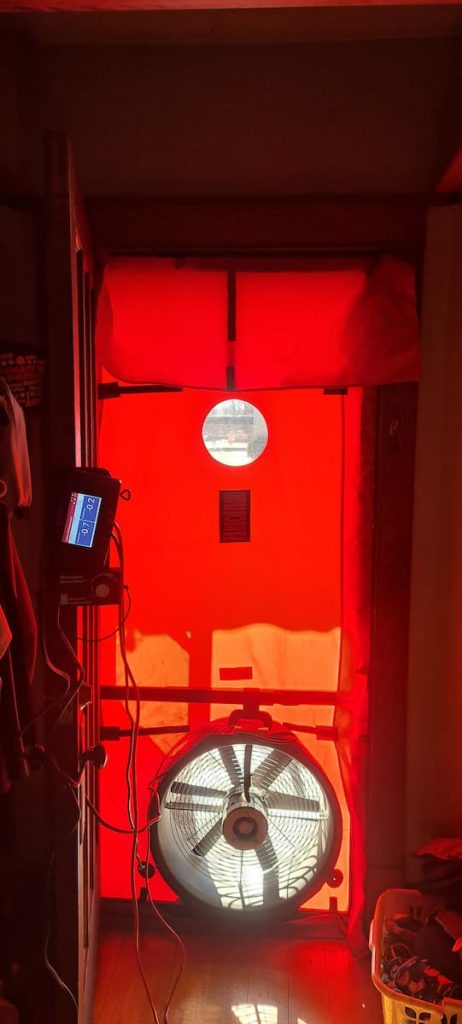
A home performance contractor uses diagnostic tools to measure what’s actually happening before recommending anything. The most important of these is a blower door test — a calibrated fan that temporarily depressurizes your home to measure precisely how much air it’s losing. Combined with an infrared camera, we can find exactly where that air movement is happening and show you the evidence before a single recommendation is made.

We also measure after the work is done. That before and after comparison is your proof that the job accomplished what it was supposed to — not just our word for it.

If a contractor can’t explain how they’ll measure the problem before they fix it, that’s worth paying attention to.


Question 3 to Ask Your Insulation Contractor: How Are Your Installation Staff Trained?

The answer to this question will tell you more than almost anything else about what kind of contractor you’re dealing with.

“They’re experienced” is not a training standard. Experience means someone has done something many times — it doesn’t mean they’ve done it correctly, or that they understand why what they’re doing matters. Building science has a body of knowledge behind it, and the professionals who practice it seriously pursue recognized certifications that verify that knowledge.

At Home Energy Solutions, every new employee earns their Building Performance Institute Building Science Principles certificate before they’re allowed to work in a customer’s home. The Building Performance Institute — BPI — is the nationally recognized credentialing organization for home performance professionals. Their certifications require demonstrated knowledge of how homes work as systems, not just how to install a specific product.

We’re also currently the only home performance and insulation contractor in northeast Wisconsin with a BPI certified Building Analyst on staff. That certification requires a higher level of diagnostic and analytical expertise — and it means the person assessing your home understands not just what to look for, but why it matters and what to do about it.

Ask any contractor you’re considering what certifications their staff hold. Then look them up.


The Bigger Picture

These three questions aren’t designed to be a gotcha. Most insulation contractors are honest people doing their best with the knowledge and tools they have. But the home improvement industry has a fragmentation problem — different trades solving different pieces of the same puzzle, often without talking to each other or understanding how their piece affects everything else.

Building science exists to solve that problem. It treats your home as a complete system rather than a collection of isolated components. A contractor who understands building science doesn’t just install insulation — they diagnose why your home is uncomfortable, inefficient, or unhealthy, and address the actual cause.

The questions above are designed to help you find that contractor. Whether that’s us or someone else, you deserve to work with someone who can answer them confidently.


One More Thing Worth Asking Yourself

Before you call anyone, it’s worth knowing what problem you’re actually trying to solve. Are you uncomfortable? Are your energy bills too high? Do you have moisture or air quality concerns? The clearer you are about the symptom, the better any contractor can diagnose the cause.

If you’re not sure where to start, that’s exactly what a home energy assessment is for. Learn more about our assessment process here.


Contact us or fill out our estimate request form and we’ll start the conversation. We’ll ask you the right questions too.


What Makes a Home Performance Contractor Different From an Insulation Company?

If you’ve gotten a quote from an insulation contractor and something felt off — even if you couldn’t quite put your finger on what — you’re probably picking up on something real.

We hear this regularly. Someone calls us, a home performance contractor, after talking to an insulation company, and when we ask what prompted the second call, the answer is usually some version of “I don’t know, it just didn’t feel right.” That instinct is worth trusting. Here’s what it’s likely telling you.


There’s a Difference Between Buying Insulation and Solving a Problem

Insulation is a product. Home performance is a process.

When you call an insulation contractor, you’re essentially shopping in the commodity market — the same way you’d shop for a new water heater or a load of gravel. The goal is to get the product installed at the best price. There’s nothing wrong with that approach if insulation alone is genuinely what your home needs.

But most homes don’t just need insulation. They need someone to figure out why they’re uncomfortable, inefficient, or unhealthy — and then address the actual cause, not just the most obvious symptom. That’s a fundamentally different kind of work, and it requires a fundamentally different approach.


The One-Gun Problem and Why Your Home Needs a Holistic Approach to Home Performance

Every trade knows their thing. And every trade can only offer solutions in terms of their thing. If their thing can’t solve the problem, then as far as they’re concerned, there is no problem.

It’s a little like hunting with one specific gun. If you can’t kill it with that gun, you don’t eat — so problems that can’t be solved by whoever got called tend to get “sorta-solved” instead.

Two examples most Wisconsin homeowners will recognize:

Inconsistent temperatures. When part of your house is always too cold or too hot, the natural thought is: “What keeps my house comfortable? My heating and cooling system. So that must be the problem.” The HVAC company that gets the call sends a salesperson. The salesperson gets paid when they sell something HVAC-related. So, surprise surprise, something in your heating or cooling system needs to be replaced or upgraded. If they thought about it on a larger scale, they’d see the air leakage and insufficient insulation as the real problem — and recommend a different contractor entirely. But that doesn’t put food on their table, so it doesn’t come up.

Window condensation and drafts. The replacement window industry has done a remarkable job convincing homeowners that drafts, condensation, and high energy bills are caused by bad windows — and that replacing them will fix everything. We’ve been in homes where window replacement contracts left homeowners owing more than the work was worth, at interest rates that guaranteed years of payments — and the comfort problems were exactly the same when it was done. That’s not an accident. It’s what happens when the solution has to fit the product being sold.

A home performance contractor looks at all of the systems, identifies the actual causes, and guides homeowners toward the real solution — even when that solution isn’t something we sell.

It’s a large part of the reason we charge for a home energy audit. It allows us to give honest advice when our contracting services aren’t part of the answer.


What We Actually Do That Most Contractors Don’t

Here’s where the difference becomes concrete.

We thoroughly air seal the attic — all of it.

Most straight insulation contractors don’t air seal at all. Other home performance contractors in our market do some. We operate on the principle that if one section of a wall plate is leaking, the rest of it probably is too — so it may as well all get sealed. Partial air sealing is a little like patching half the holes in a boat and calling it fixed.

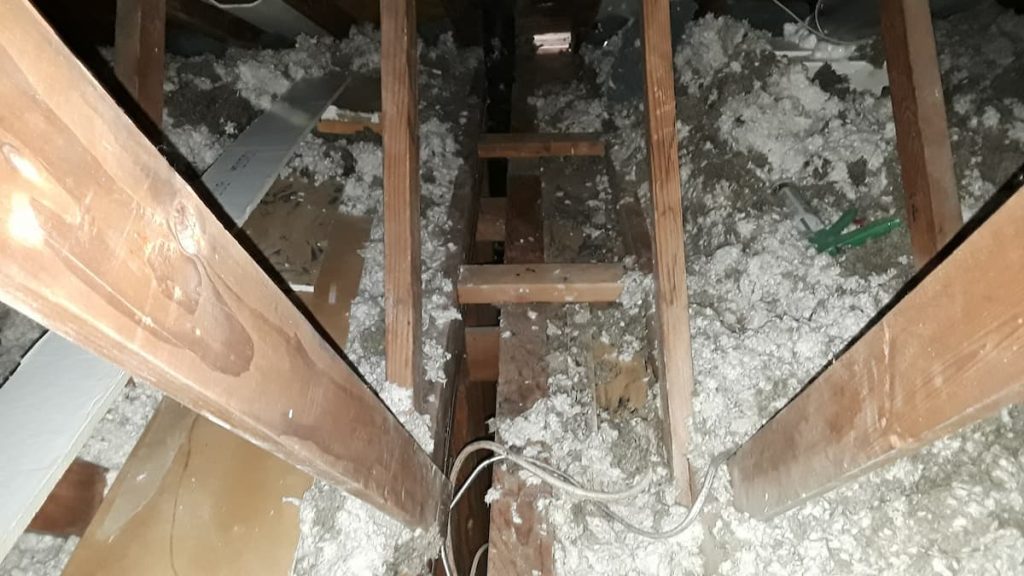
A thermal bypass in an attic before air sealing — an open pathway between your living space and the attic that insulation alone can’t address.
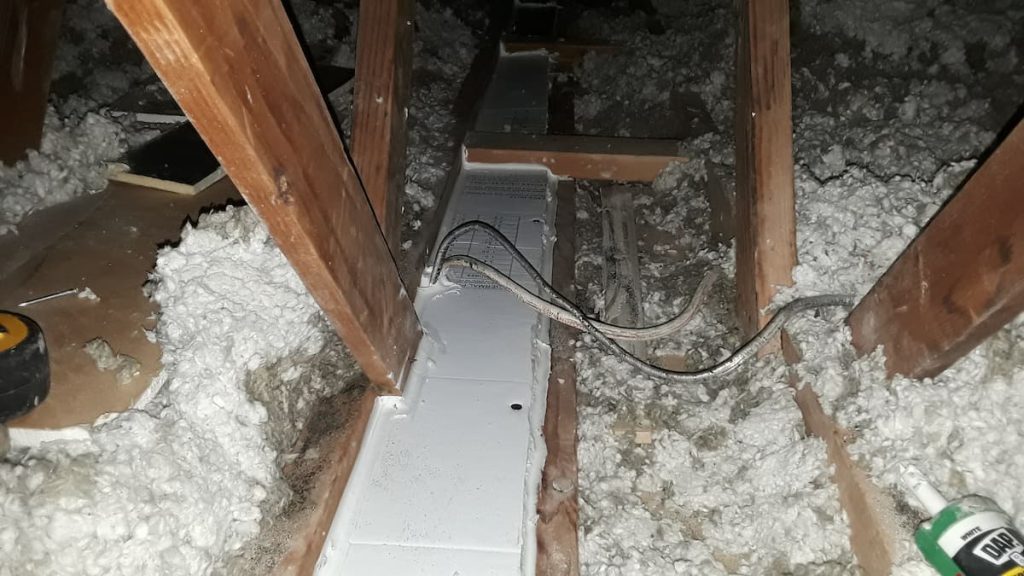
The same bypass after air sealing. Rigid board and sealant close the pathway completely before insulation is added.

We audit every venting appliance in the home.

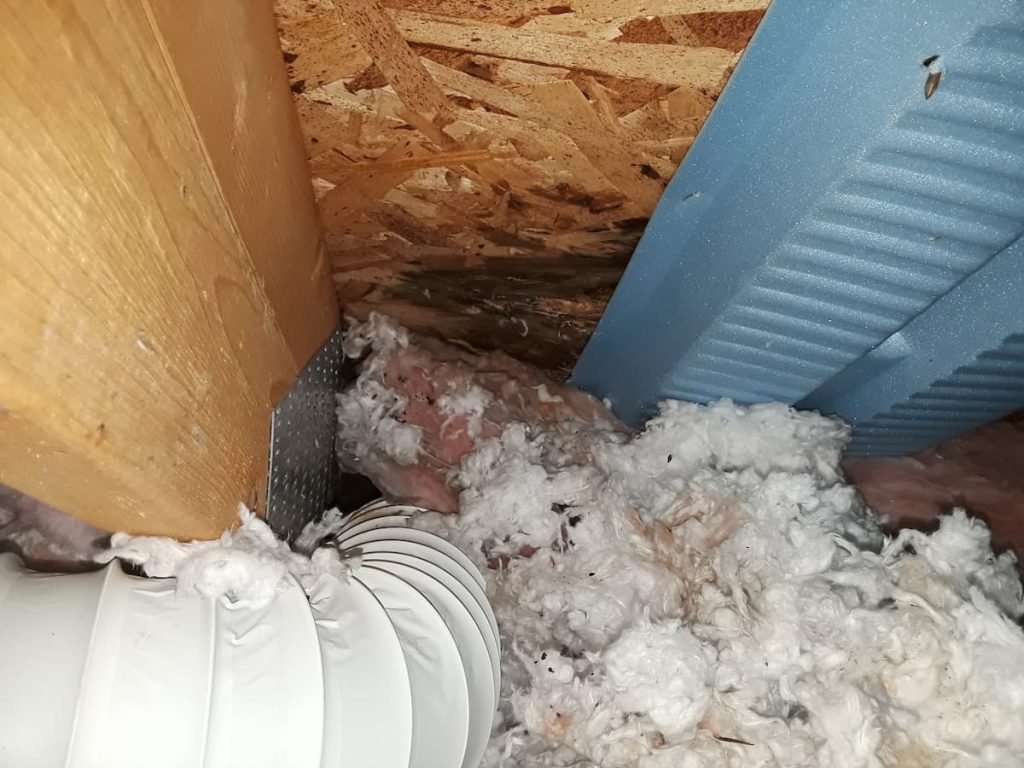
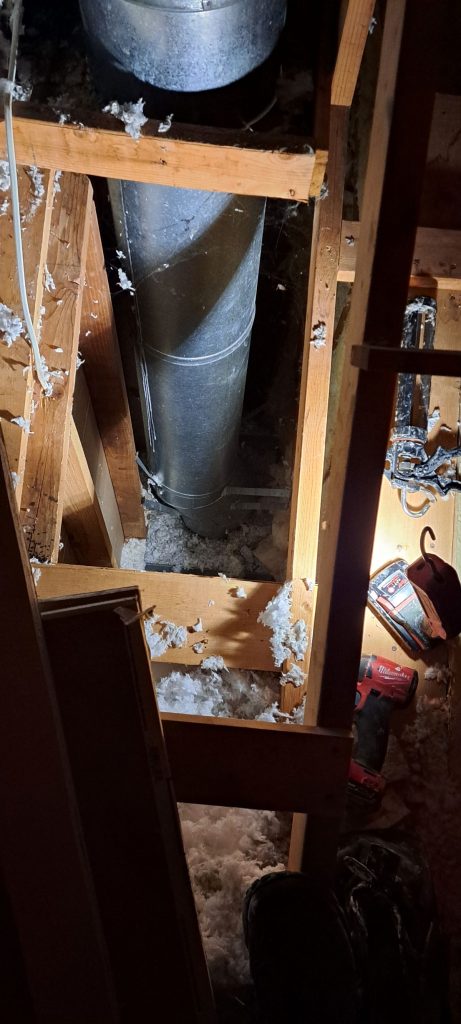
Furnaces, water heaters, bathroom exhaust fans, kitchen exhaust fans — we make sure they’re all exhausting properly before we add insulation. This matters because we regularly find bathroom and kitchen fans venting directly into the attic rather than outside the home. Once insulation is added, that becomes a significant moisture problem. We also find situations where a brick chimney has been dismantled to just below the roofline — which sounds fine until you realize it leaves a direct air pathway from the basement all the way to the attic. Some of the moisture damage photos in our earlier post came from exactly that situation.

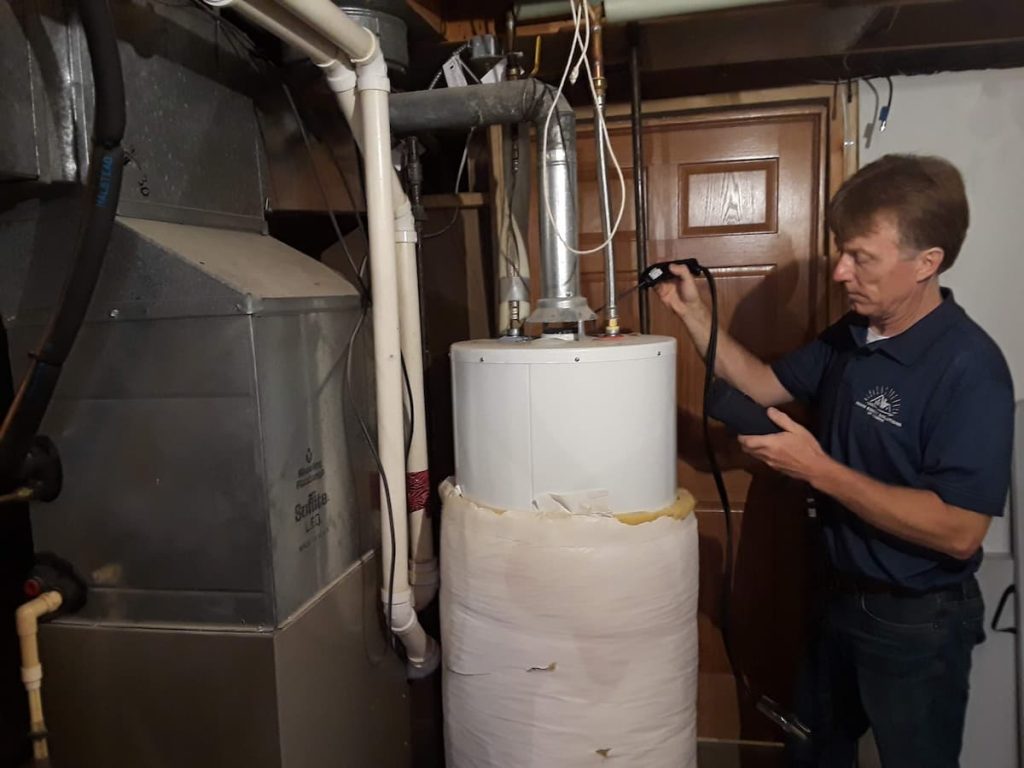
Combustion safety testing of a water heater and furnace. We check every gas appliance in the home — something most insulation contractors never do.
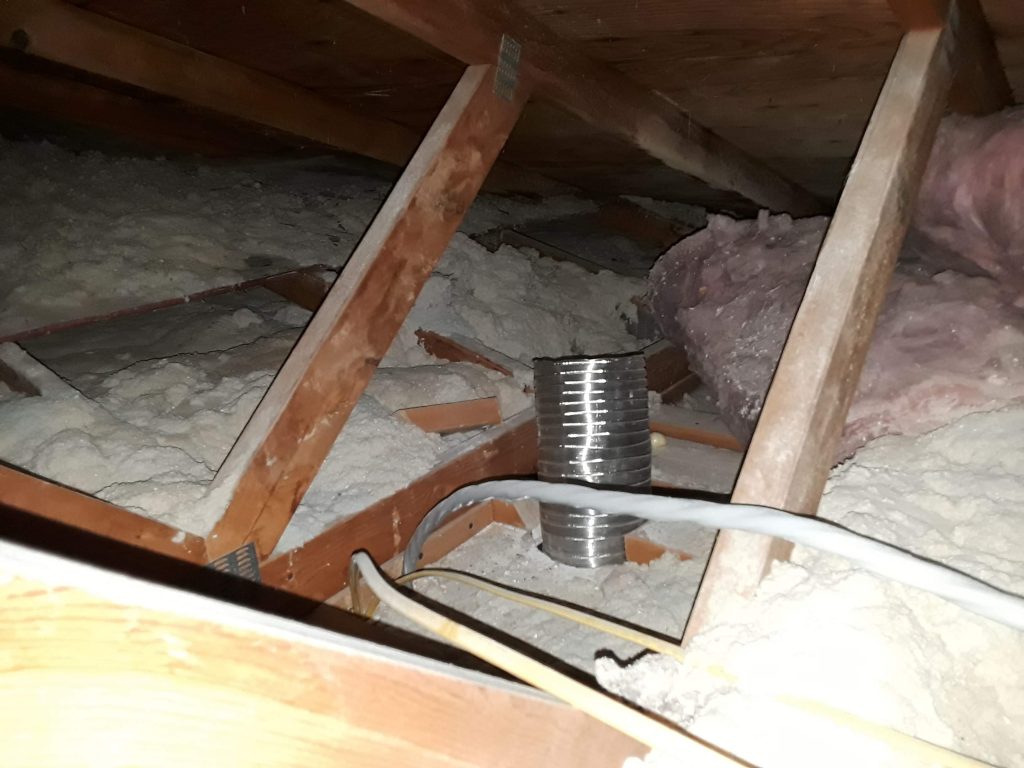
A bathroom exhaust fan venting directly into the attic. Every time this fan runs, warm moist air goes straight into the attic space — a problem that gets significantly worse once insulation is added.
A bathroom exhaust fan vented into the soffit rather than properly exiting the home. This sends warm moist air directly back toward the attic intake, defeating the purpose of the vent entirely.

We check attic ventilation.

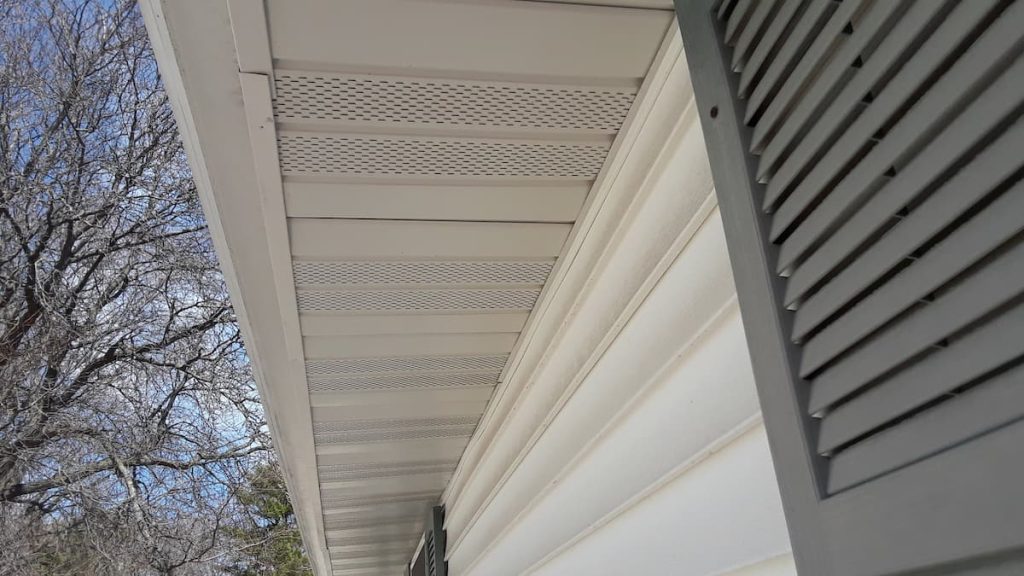
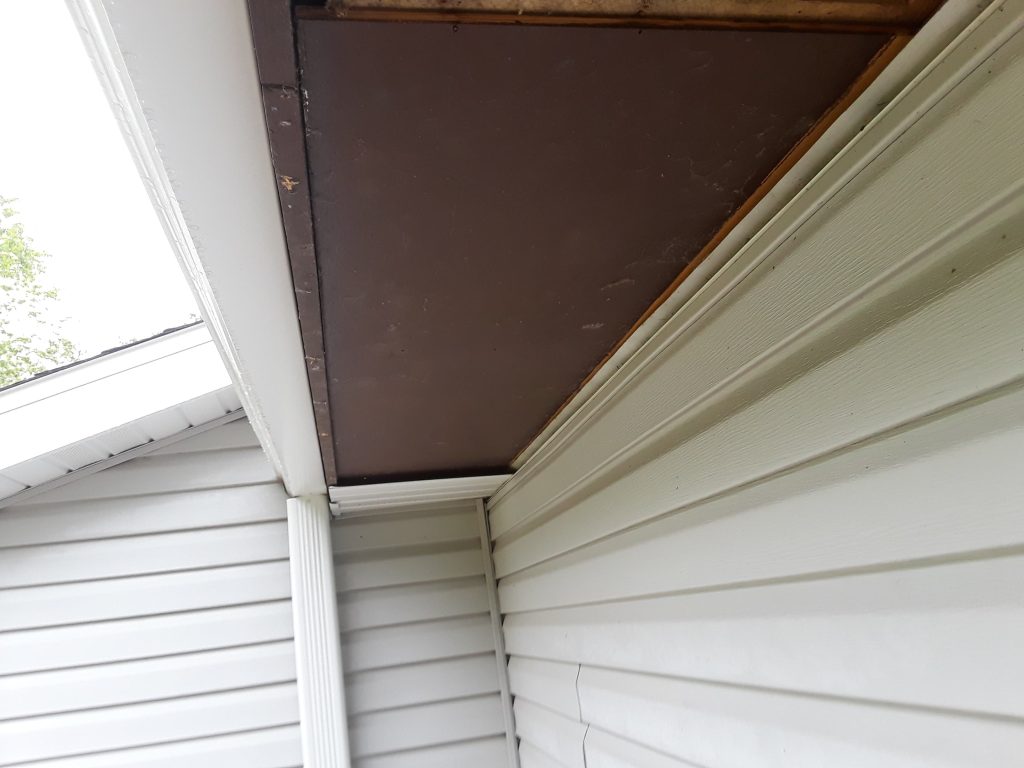
Proper attic ventilation requires intake air at the soffits and exhaust at the ridge. We regularly find homes where vented soffit panels were installed directly over the original solid panels — which means no air is actually getting in, regardless of what it looks like from the ground. That leads to moisture buildup in the attic over time.

From the outside, this soffit looks exactly right. Vented panels, properly installed — nothing unusual to see here.
A closer look tells a different story. The vented panel is there, but the original solid plywood behind it was never removed or cut open. No outside air is actually getting into this attic — and the homeowner had no way of knowing.

We don’t skip the hard parts.

In the basement sill area, there’s a section that frequently gets missed or omitted by other contractors — not because it’s complicated, but because it’s not easy to access and takes extra time. We do it anyway. Similarly, kneewalls are sometimes sealed using a shortcut that technically follows the intent of building codes, but can still leak air. We seal those gaps.


The Accountability Question

We’re currently the only home performance and insulation contractor in northeast Wisconsin with a BPI certified Building Analyst on staff.

That matters for a specific reason that isn’t always obvious. When the person identifying the problems and the people solving them aren’t part of the same organization, there’s a real risk that the recommended work won’t get done the way it should. The contractor’s crew takes direction from their boss, not from the analyst who wrote the assessment. There’s no enforcement mechanism — and no one person who’s accountable for the gap between what was recommended and what actually got done.

There’s also a less discussed issue in the industry: when an independent analyst sends a homeowner’s assessment out to multiple contractors for quotes, the contractor who offers the analyst the highest finder’s fee is often the one whose quote gets shown to the homeowner. The homeowner believes they’re getting an objective recommendation. They’re frequently not.

Our model closes that loop. The same person who diagnoses your home is accountable for the quality of the work that gets done to it. When something isn’t right, there’s immediate feedback to the person responsible — and an immediate requirement to fix it.

Additionally, every new employee at Home Energy Solutions earns their Building Performance Institute Building Science Principles certificate before they’re allowed to work in a customer’s home. The standard isn’t just about credentials on paper — it’s built into how we bring every person onto our team. We’re actively pursuing additional certifications as our industry continues to evolve.


What This Means for Your Comfort

About 30% of our work involves going behind another contractor’s work, correcting their mistakes. Some of that is genuinely bad workmanship. Much of it is simply that building science has evolved — we didn’t know then what we know now, and work that met the standard of its time doesn’t meet today’s understanding of how homes actually perform.

What we find most often: air sealing that wasn’t done at all, or was done half-heartedly. Insulation installed incorrectly, leaving sections of the attic under-insulated or uninsulated entirely. Kneewalls sealed with shortcuts. Basement sill areas skipped because they’re inconvenient.

This attic had already been professionally treated for mold — the white coating on the roof deck is the treatment. Without air sealing to address the source of moisture, the mold came back. Treating the symptom without fixing the cause is exactly what a whole-house approach is designed to prevent.

The result in every case is the same: a home that’s less comfortable, less efficient, and in some cases less healthy than it should be — and a homeowner who was told the job was done.

Home performance looks at how all of the components of a house work together. Not just the insulation. Not just the HVAC. Not just the windows. All of it — because comfort, efficiency, health, and safety aren’t separate problems. They’re the same problem, looked at from different angles.

That’s what a home performance contractor does. And it’s why, when something feels off about the other quote, it usually is.


Contact us here or fill out our estimate request form to start the conversation. We’ll walk through your home with you, tell you what we see, and give you an honest picture of what it needs — whether or not we’re the ones who can take care of it.


What Is a Home Energy Audit — and Do You Actually Need One?

If you’ve been looking into ways to make your Wisconsin home more comfortable, improve your air quality, or lower your energy bills, you’ve probably come across the term “home energy audit.” It sounds official — maybe even a little intimidating — and it’s not always clear what it actually involves or whether it’s worth your time.

Here’s a plain-language explanation of what a home energy audit is, what ours looks like specifically, and how to know whether it makes sense for your situation.


What a Home Energy Audit Actually Is — and Why Wisconsin Homes Need One

A home energy audit is a systematic diagnosis of how your home uses and loses energy — and how that affects your comfort, your air quality, and your monthly bills. The goal isn’t to sell you a list of products — it’s to understand what’s actually happening in your specific home before recommending any work.

Think of it like a doctor’s appointment before a diagnosis. A good doctor doesn’t walk in and start writing prescriptions. They ask questions, run some tests, look at what the numbers tell them, and then explain what they found in plain language. A home energy audit works the same way.


What Ours Looks Like

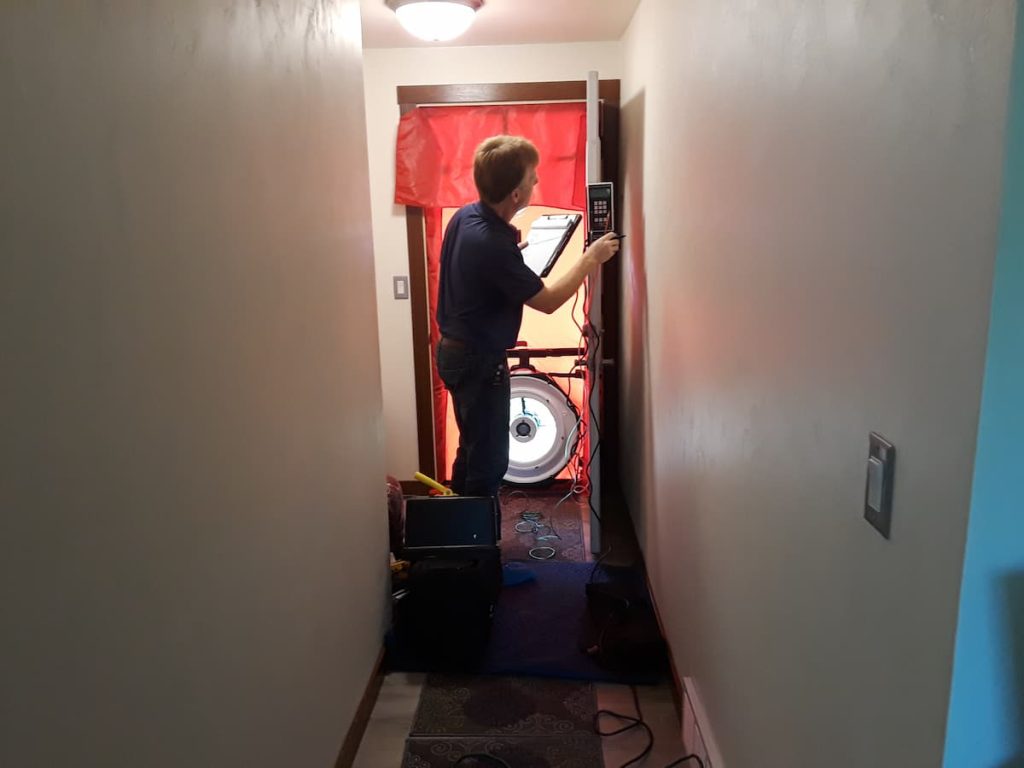
A blower door test in progress. The calibrated fan fits into an exterior doorway and depressurizes the entire home, allowing us to measure exactly how much air it’s losing.
The blower door fan and pressure gauge mid-test. The reading on the gauge tells us precisely how airtight — or how leaky — your home is.

When we come to your home, we start by asking questions — about your utility bills, about the rooms that never seem comfortable, about any moisture, odor, or air quality issues you’ve noticed. Your experience living in the home is data, and it’s often the most useful data we have.

From there we conduct a blower door test. This involves temporarily sealing your home and using a calibrated fan to depressurize it — essentially putting your house under a controlled vacuum. The equipment tells us precisely how much air your home is losing, which is a key indicator of both energy efficiency and indoor air quality. While the house is depressurized, we can use other tools to find exactly where that air movement is happening.

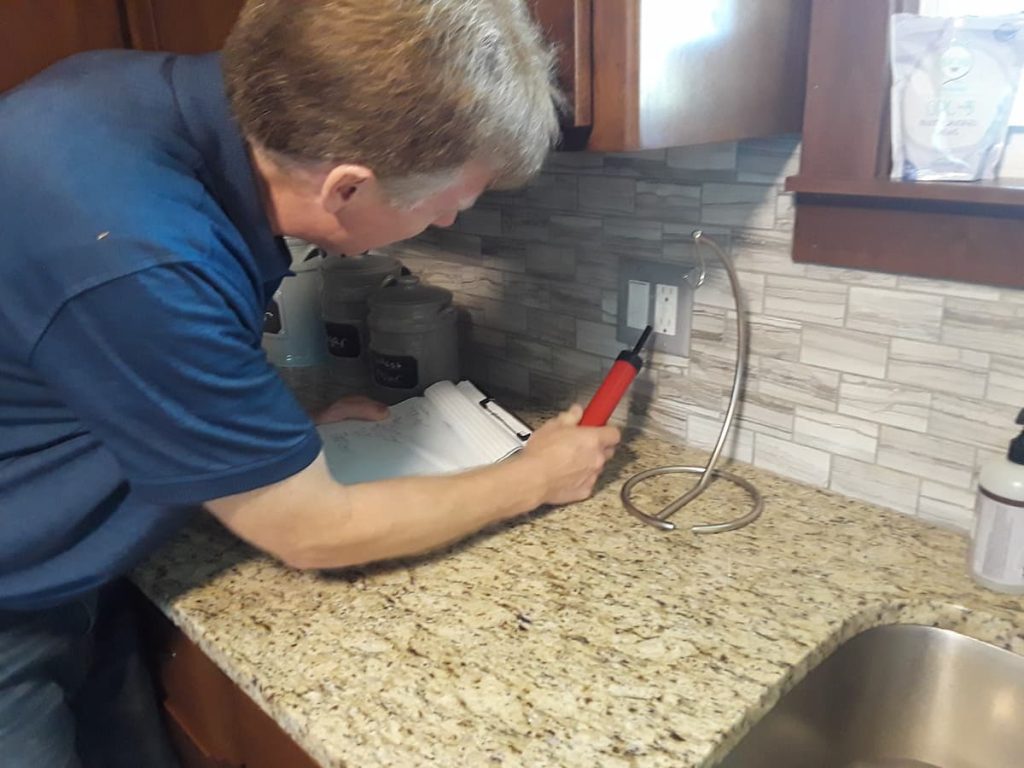
Checking for air leakage at a wall outlet during a home energy audit. Outlets on exterior walls are a surprisingly common source of air infiltration that most homeowners never suspect.

We also perform combustion safety testing on your gas appliances — furnaces, water heaters, and similar equipment. This is a requirement of our BPI certification and something many contractors skip entirely. It checks that your appliances are operating safely and not introducing harmful byproducts into your home’s air. It takes a few minutes and has caught serious problems in homes that looked perfectly fine on the surface.

Finally, we do a visual inspection of your attic, basement, and crawl space — the areas most homeowners rarely see and that most commonly drive comfort and efficiency problems.

At the end, you get a clear picture of what we found and what we’d recommend, in order of impact. No jargon, no pressure. Just information, so you can make a confident decision about what to do next.


Do You Actually Need One?

Not always — and we’ll tell you that upfront.

If you have a specific, well-defined problem — say, an under-insulated attic in a newer home with no air sealing concerns — we may be able to give you a straightforward recommendation without a full audit. We’re not going to recommend a process you don’t need.

But if you’ve been dealing with comfort problems that don’t have an obvious explanation, if your energy bills have been stubbornly high despite previous work, or if you’re starting to notice moisture, odors, or air quality concerns, an audit is almost always the right starting point. It makes sure we’re solving the actual problem rather than guessing.

An audit is also a valuable planning tool. Even if you’re not ready to do any work right now, knowing what your home needs — and in what order — lets you budget intelligently and make improvements on your own timeline rather than reacting to problems as they come up. We find that many homeowners appreciate having a clear picture of their options before committing to anything.

And sometimes people call us simply because they’re curious about their home. They’re not sure if anything is wrong, but they want to know if there are things they could or should be doing to make it more comfortable and efficient. That’s a completely valid reason for an audit — and often the most interesting ones we do, because there’s no preconceived idea of what we’ll find.


The Focus on Energy Connection

Wisconsin’s Focus on Energy program supports home energy audits as part of its rebate process. For many homeowners, the audit is the first step toward qualifying for rebates on air sealing and insulation work. We’re a certified Focus on Energy Trade Ally, which means we can walk you through that process from start to finish.

If you’re not sure whether an audit makes sense for your situation, just give us a call. We’re happy to talk it through — no commitment required.


Contact us here or fill out our estimate request form to get started.


Why Is My Home Still Uncomfortable After Adding Attic Insulation?

You thought you did everything right. You had insulation added to your attic hoping for a more comfortable home and lower energy bills, and… not much changed. The rooms that were cold before are still cold. Maybe the bills dropped a little, but nowhere near what you were hoping for. Now you’re wondering whether you were sold something that didn’t work, or whether you missed something along the way.

Here’s the straightforward answer: the insulation probably did work. It just didn’t work alone — because insulation only solves part of the problem.


Two Ways Buildings Lose Heat — and Why Both Matter

Heat escapes a home in two primary ways that we can actually do something about.

The first is conduction — heat passing through solid materials. Picture a cold glass of ice water. Even before you touch it, you can feel the cold near your hand. What’s happening is the warmth from your body is traveling through the air, through the glass, and into the ice, because heat always moves from warm to cold, looking for balance. Your walls, ceiling, and floors do the same thing — constantly conducting heat toward wherever it’s coldest. Insulation slows that process down significantly. That’s its job, and it does that job well.

The second way is convection — and this is the one most insulation jobs leave completely unaddressed. Air is a gas, and gases move from areas of high concentration to low concentration, always looking for balance. Think about pouring that glass of water onto a flat surface. It doesn’t stay in a column — it spreads out in every direction immediately. The warm, heated air inside your home does exactly the same thing, finding every gap, crack, and opening it can squeeze through and moving toward the cold outdoors — taking your energy dollars with it.

Insulation slows conductive heat loss. It does almost nothing to stop air movement.


Here’s Where It Gets Important

When warm air from inside your home moves into your attic, it carries moisture with it — because warm air always contains water vapor. When that air hits the cold attic space, it cools down. If it cools down enough to reach what’s called the dew point — the temperature at which air can no longer hold its moisture — that water vapor turns into liquid water inside your attic or wall cavity.

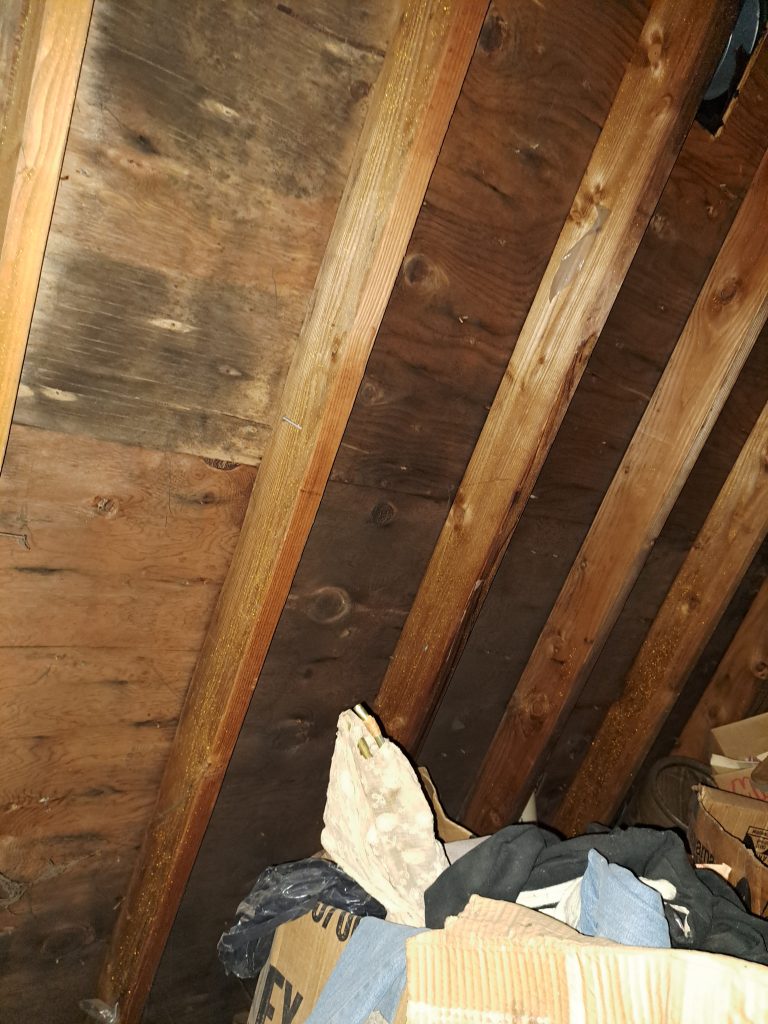
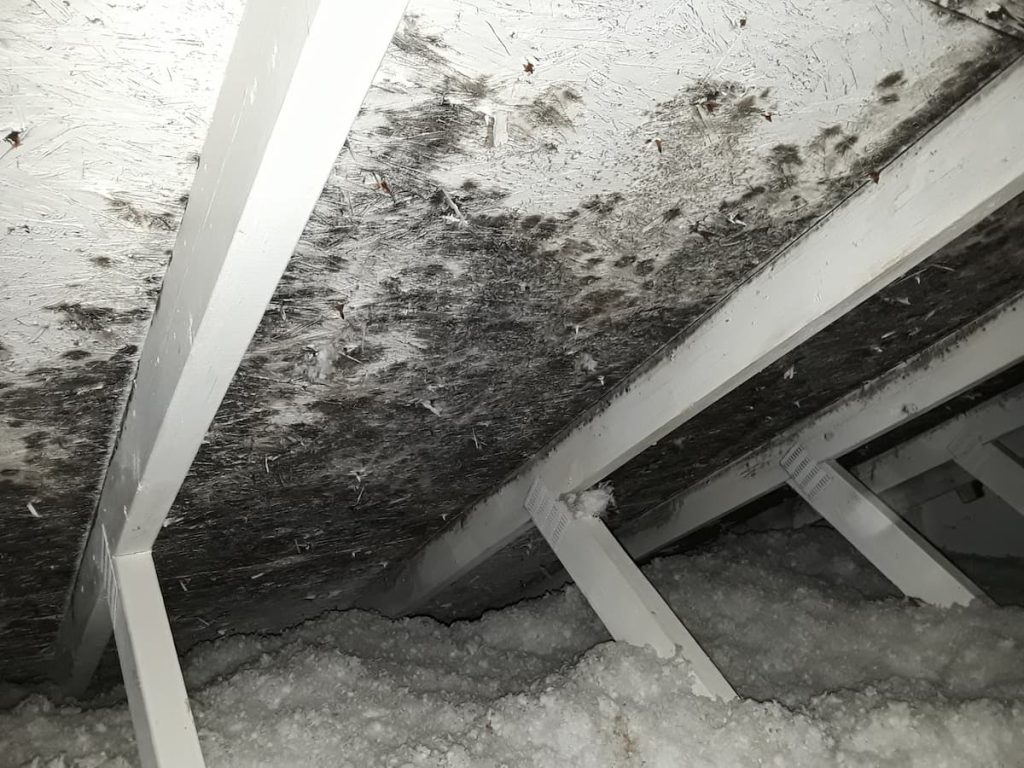
Moisture staining on attic roof sheathing – the result of warm, humid air from the living space repeatedly condensing in the attic over time.

Now here’s the part that surprises most homeowners: adding insulation without air sealing can actually make this moisture problem worse, not better.

Here’s why. Better insulation keeps your attic colder than it was before — which means the warm, humid air moving through those unsealed gaps reaches its dew point sooner than it did previously. The air movement didn’t stop. You just made the conditions inside your attic more favorable for condensation.

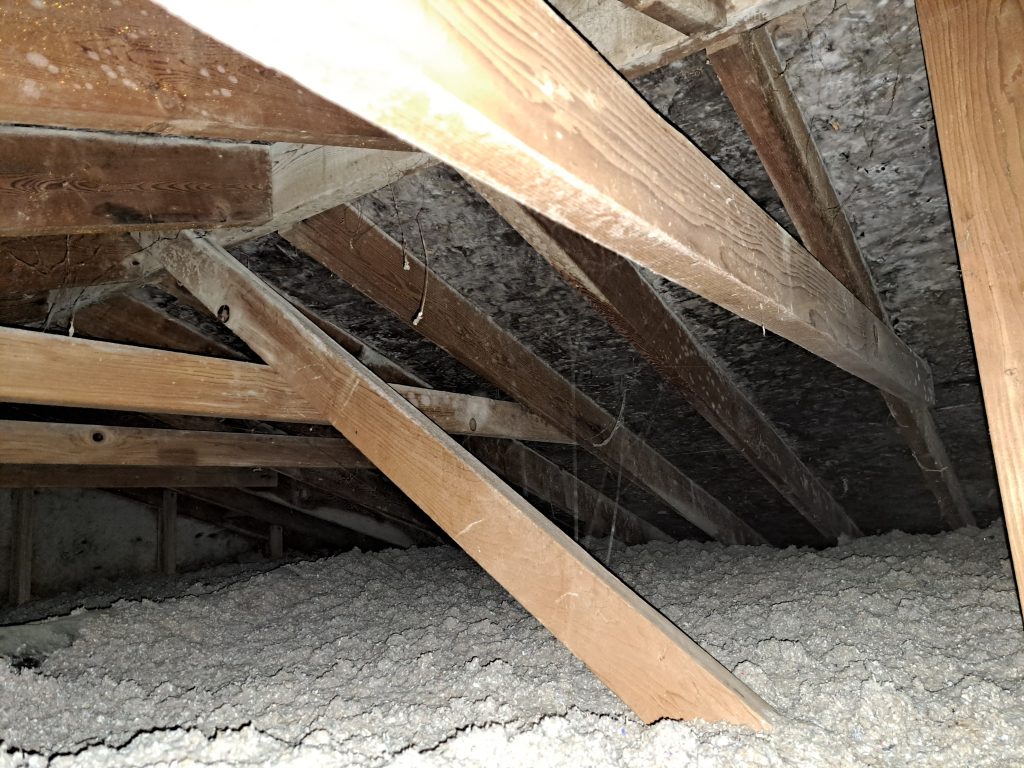
This attic has blown-in insulation of the floor – but without air sealing, warm moist air continued moving through gaps into the attic. The result is the gray and black mildew covering the roof deck above. This damage is permanent.
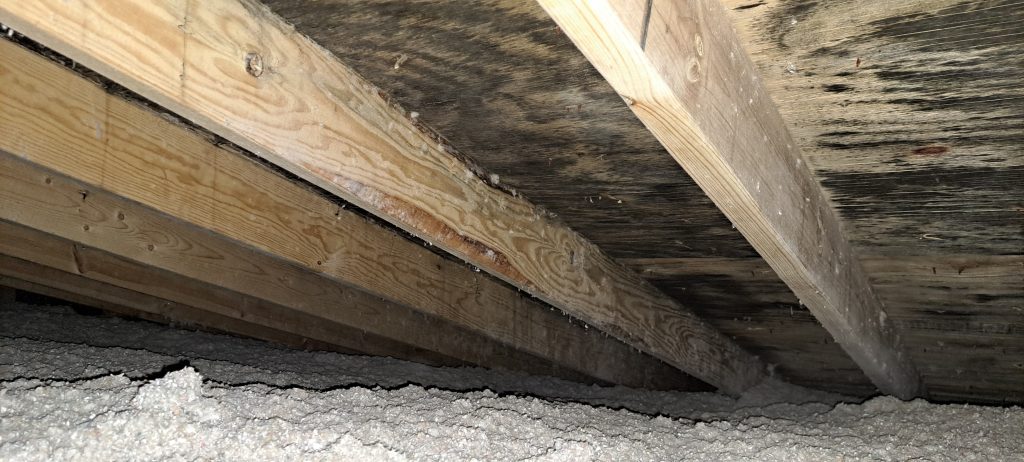
A closer look at the same problem. The insulation is visible at the bottom of the frame – and the staining on the sheathing and rafter above it tells the story of what happened when air sealing wasn’t part of the job.

We know this happens because we’ve seen it firsthand. When we get into attics in homes that had insulation added without air sealing, moisture damage is one of the most common things we find — sometimes years after the original work was done.


What a Complete Job Looks Like

A home performance contractor — as opposed to a straight insulation installer — treats your home as a system. That means understanding how air moves through your specific house before recommending any work, air sealing the gaps and bypasses that insulation can’t address, and then installing the right amount of insulation for your situation.

We use a blower door test to measure exactly how much air your home is losing and find where it’s going. That information drives the work — which means you’re not paying for things your house doesn’t need, and you’re not missing the things it does.

The right sequence is always air sealing first, insulation second.


What About Focus on Energy Rebates?

Wisconsin’s Focus on Energy program offers incentives for both air sealing and insulation — but the two are linked. In most cases, one requires the other to be done at the same time to qualify, and eligibility depends on the existing insulation levels in your specific home. Every house is different.

If insulation was added to your home previously without air sealing, you may still be eligible for incentives on the next phase of work — but the only way to know for certain is to have someone come out and take a look. We’re a certified Focus on Energy Trade Ally, and walking through eligibility with homeowners is part of what we do. There’s no obligation in that conversation — just information, so you can make a confident decision.


The Bottom Line

If you had insulation added and didn’t see the results you were expecting, the missing piece is almost certainly air sealing. The good news is that it’s fixable, and in many cases there are still incentives available to help with the cost.

Contact us here or fill out our estimate request form to get the conversation started. We’ll take a look at what’s happening in your home and give you an honest picture of where things stand.


Why Is One Room in My House Always Colder Than the Rest?

If you’ve got a cold room in your house every winter — a bedroom that never warms up, an upstairs that feels like a different house than your main floor, or a room that’s stuffy and hot every summer — you’re not imagining it, and it’s not just the way your house is built. It’s one of the most common complaints we hear from Wisconsin homeowners, and it almost always has a real, fixable cause.

Here’s the thing most people don’t know: that cold room in winter is almost certainly the same room that’s too warm in summer. Same problem, opposite season.


Why the Same Room Is Uncomfortable Year-Round

Buildings in cold climates like Wisconsin are constantly trying to find balance. In winter, heat inside your home moves toward the cold outdoors. In summer, heat outside moves toward your cooler interior. This happens two ways, and understanding both is the key to understanding why one room keeps giving you trouble.

The first is conduction — heat passing through solid materials. Picture a cold glass of ice water. Even before you touch it, you can feel the cold near your hand. What’s happening is the warmth from your body is traveling through the air, through the glass, and into the ice, because heat always moves from warm to cold. Your walls, ceiling, and floors do the same thing — slowly conducting heat in whatever direction the temperature difference pushes it.

The second — and more important — way is convection. Air is a gas, and gases move from areas of high concentration to low concentration, always looking for balance. Think about pouring that glass of water onto a flat surface. It doesn’t stay in a column — it spreads out immediately in every direction. Warm air inside your home behaves exactly the same way, constantly pushing outward through any gap or opening it can find.

Convection is typically the bigger culprit in comfort problems. And the gaps it moves through are almost never where you’d think to look.


What People Usually Think — and What’s Actually Happening

When one room is cold, most homeowners assume it’s a heating system problem. Maybe the furnace isn’t powerful enough, or the duct run to that room is too long, or the room is just too far from the source. Those are reasonable guesses, but they’re usually wrong.

What’s more likely happening is that the heated air is getting to that room — it’s just leaving before it can do its job. Warm air finds the gaps and cracks in that space and moves toward the cold outdoors, taking the heat with it before it ever warms the room up. Your furnace runs longer trying to compensate, your energy bill goes up, and the room stays cold.


Where the Air Is Actually Going

This is where it gets surprising. The gaps that matter most aren’t usually at windows or doors — those are the obvious ones homeowners already think about. The real culprits are the ones you can’t see without the right tools.

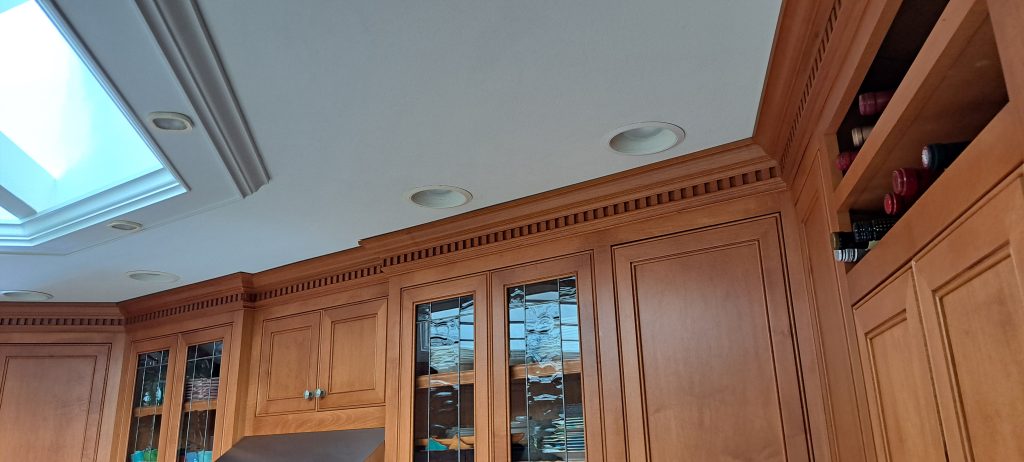
A perfectly ordinary-looking ceiling – nothing obviously wrong.
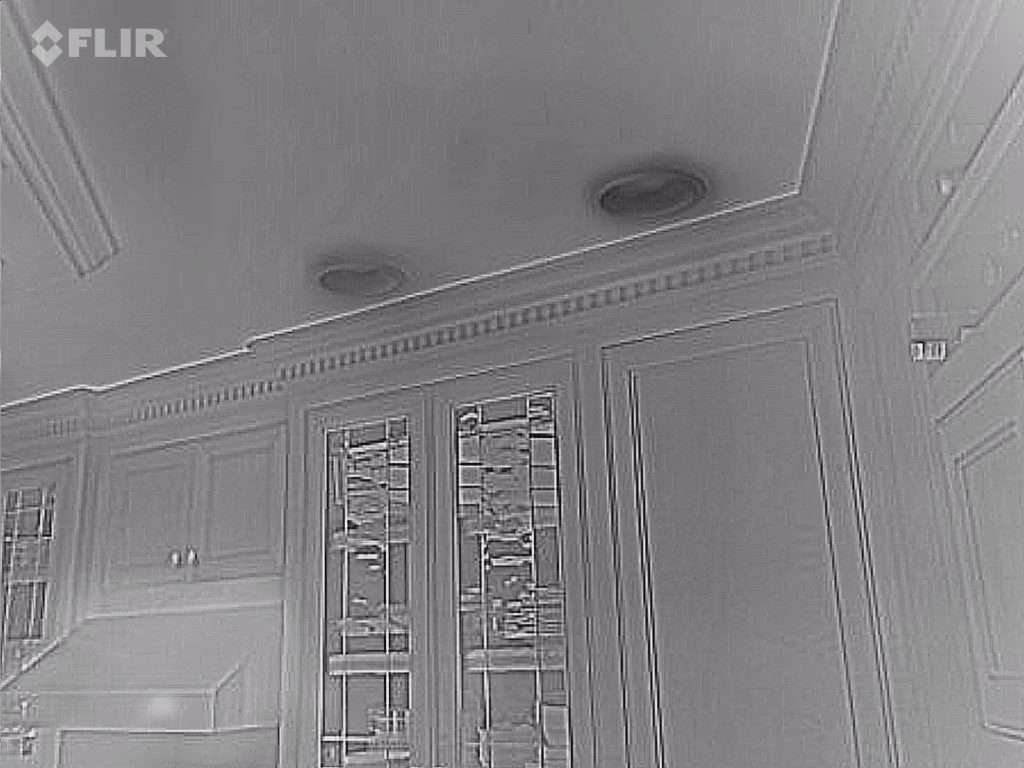
The same ceiling through an infrared camera. Those dark halos around each recessed light show exactly where cold air is infiltrating from the attic above.

Recessed light fixtures — the kind installed in millions of Wisconsin homes built from the 1980s onward — are essentially open holes between your living space and your attic. Each one is a small gap, but a room with eight or ten of them adds up quickly.

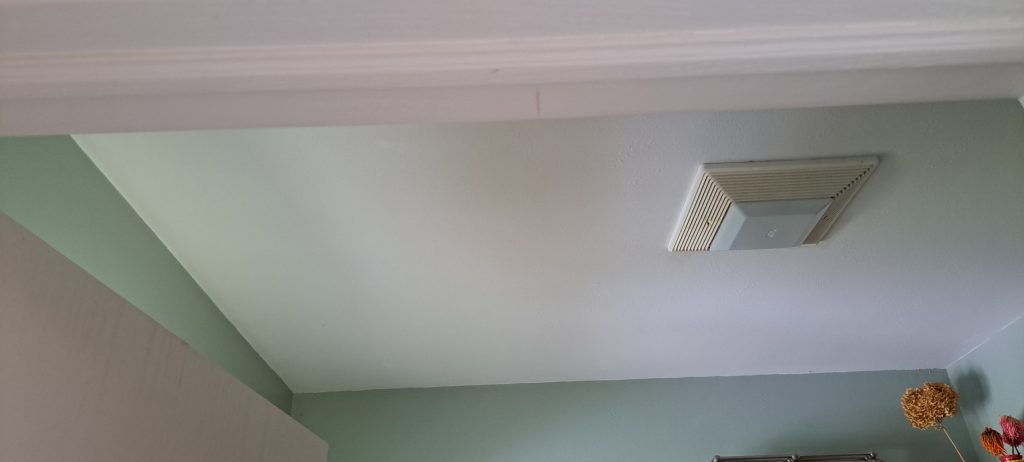
A standard bathroom exhaust fan. Nothing unusual to the naked eye.
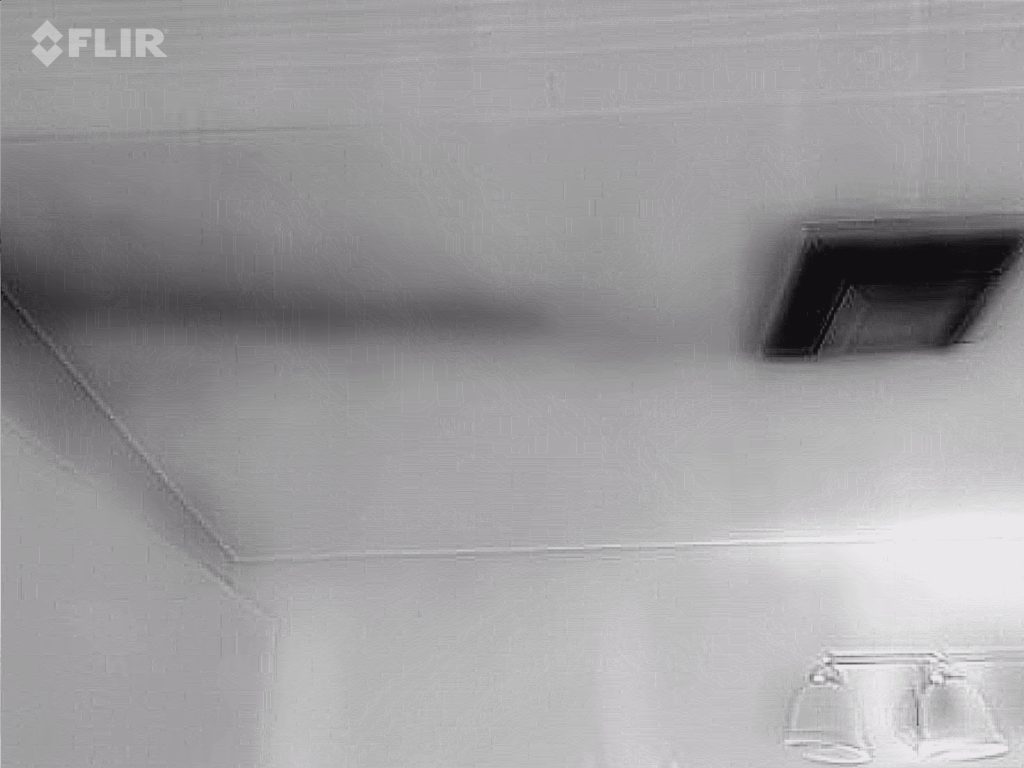
Infrared tells a different story. The dark area shows cold air streaming in around the unsealed fan housing.

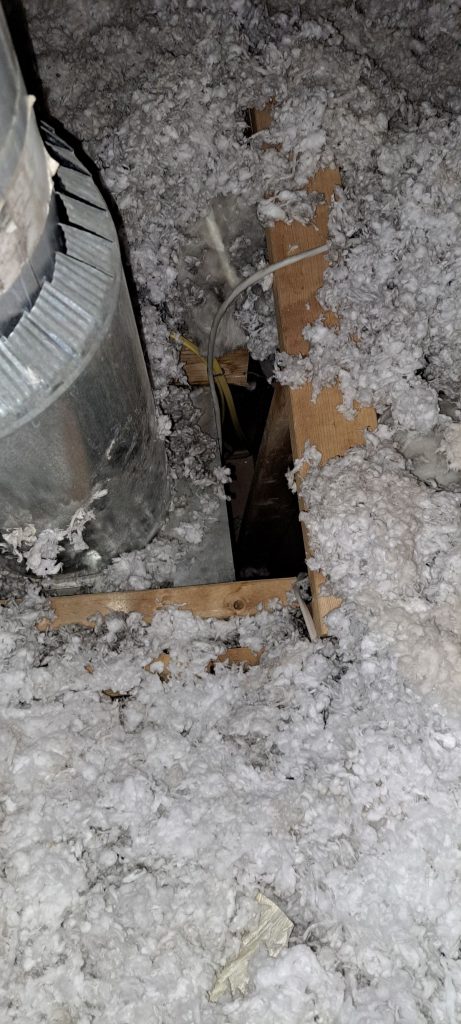
Bathroom exhaust fans are another common problem area. The fan itself may work fine, but the housing around it is often unsealed, creating a direct pathway between your bathroom ceiling and the cold attic above.

The open framing cavity above a built-in fireplace – a direct pathway from the living space to the attic.
A ceiling bypass in an attic, typically found behind a linen closet. Existing insulation surrounds it — but insulation doesn’t stop air movement.

Fireplace chases, the framing cavities behind linen closets, gaps around plumbing and electrical penetrations — these are what building science people call “bypasses.” They’re open pathways that connect your living space directly to your attic. Warm air finds them immediately, because that’s what warm air does.


Why Insulation Alone Doesn’t Fix It

This is the part that surprises most homeowners. Insulation slows conductive heat loss — it makes a real difference. But it does almost nothing to stop air movement. Blown-in insulation sits in your attic like a blanket of material, but air moves right through it and around it.

Adding insulation without first air sealing those bypasses and penetrations can actually make the moisture situation in your attic worse. When warm, humid air from your living space gets into a better-insulated — and therefore colder — attic, it reaches the temperature at which it drops its moisture sooner. We know this happens because we’ve seen it firsthand. When we get into attics in homes that had insulation added without air sealing, moisture damage is one of the most common things we find — sometimes years after the original work was done.

The right sequence is always air sealing first, insulation second.


How We Find the Problem

We use a blower door test to measure exactly how much air your home is losing and depressurize the house so air movement becomes detectable. The blower door test is a Building Performance Institute standard used by certified home performance contractors across the country. Combined with an infrared camera — which is what produced the images above — we can find the specific locations where air is moving and address them directly.

The result isn’t just a more comfortable room. It’s a home that holds its temperature better, costs less to heat and cool, and handles Wisconsin winters the way it should.

If you’ve got a room that’s been giving you trouble, we’d be glad to take a look. Contact us or fill out our estimate request form and we’ll get the conversation started.

The Insulation Tax Credit Ends December 31—Don’t Miss Out on $1,200 in Savings!

A recent change in federal law means the insulation tax credit—worth up to $1,200—is ending sooner than expected. The last day to complete qualifying projects and still be eligible for the credit is December 31, 2025. That gives you a very limited window to complete insulation and air sealing upgrades and still claim your savings! 

If you’ve been thinking about improving your home’s comfort and energy efficiency, the time to act is now.

A New Law Just Eliminated the Insulation Tax Credit Early

The Energy Efficient Home Improvement Credit (also known as the insulation tax credit) was originally set to run through 2032. But Congress just passed legislation cutting the program short. After December 31, 2025, this credit will no longer be available.

That means to qualify, your project must be completed—not just scheduled—before the end of 2025.

If your work is finished by the deadline, you’ll still be able to claim the credit when you file your 2025 taxes (likely in early 2026). But any upgrades completed after the cutoff will no longer be eligible.

A Limited Time Opportunity to Boost Comfort and Lower Energy Bills—For $1,200 Less!

Waiting could mean leaving up to $1,200 in savings on the table. That’s money that could help offset the cost of insulation and air sealing—upgrades that also:

  • Lower your monthly energy bills
  • Improve indoor comfort
  • Enhance your home’s air quality

This is a dollar-for-dollar credit on your federal tax return. If you owe taxes, it directly reduces the amount you owe. But only if your insulation work is finished by year’s end.

Act Now—Our Schedule Is Filling Up Fast

With the tax credit set to expire, homeowners are hurrying to schedule their insulation upgrades before it’s too late. At Home Energy Solutions we want to help as many people as possible take advantage of this opportunity, but our calendar for the rest of the year is filling up quickly.

To ensure your project is completed in time, contact us today to reserve your slot.

Maximize Your Savings with Confidence

We’re experts in insulation and air sealing and know exactly what’s needed to qualify for the insulation tax credit. The clock is ticking, but our team is ready to:

  • Recommend qualifying insulation solutions
  • Provide a detailed, itemized invoice for tax purposes
  • Help you explore other available incentives and rebates in our area

This isn’t just about improving your home. It’s about taking advantage of a valuable incentive before it disappears for good.

Improve your comfort, cut your energy bills, and take advantage of up to $1,200 in tax credits—before the opportunity disappears. Call 888-719-5905 or contact us online today, while there’s still time to save!


How Does the Insulation Tax Credit Work?

The insulation tax credit is a great opportunity to lower the cost of upgrading the insulation and air sealing in your Wisconsin home. You can save 30% of your eligible expenses, up to $1,200 per year, making it more affordable to create a comfortable home and lower monthly energy bills.

But many homeowners are less familiar with tax credits than rebates. How is the insulation tax credit different from an insulation rebate, and how do tax credits work in general?

What is a Tax Credit?

Unlike a rebate, which is a refund or upfront discount, a tax credit reduces the amount of taxes you owe the government. The insulation tax credit, officially called the Energy Efficient Home Improvement Credit, is a federal tax credit, so it would only affect your federal taxes owed.

A tax credit offers a dollar-for-dollar reduction in your tax bill. As an example, if you go to file your taxes for the year in which you upgraded the insulation and air sealing in your home, and you owe $1,500 in federal taxes, you can use the insulation tax credit of $1,200 to reduce the taxes you owe to $300.

How the Insulation Tax Credit Process Works (in 3 Simple Steps)

  1. Work with a contractor familiar with the insulation tax credit to ensure that you meet all of the qualifications and maximize your savings! 
  2. When your home improvement work is finished, make sure your contractor provides you with an itemized invoice that includes all of the expenses eligible for the tax credit.
  3. When it’s time to file your taxes for the year in which your insulation and air sealing upgrades were made, give your invoice to your tax professional (if you are doing your taxes yourself, you can fill out Form 5695, but we always recommend leaving your taxes to professionals!).

Things the Insulation Tax Credit Does NOT Do

  1. You cannot use the tax credit to get a refund: If the amount of the tax credit you are eligible to take is more than the federal taxes you owe, you won’t be paid for the difference.
  2. You cannot roll any remaining balance to the next year: Similarly, you can’t save any remaining balance to apply to future years’ taxes.
  3. You can’t take the tax credit on non-eligible expenses: Labor costs for installing insulation and air sealing are not eligible for the Energy Efficient Home Improvement Credit. But that doesn’t mean that there isn’t plenty of savings to be had! Home Energy Solutions can help you navigate the tax credit and maximize the credit you’re eligible for.

Find Out How Much You Can Save with Home Energy Solutions

We know that every dollar counts when it comes to making investments in your home, which is why the team at Home Energy Solutions is trained and familiar with incentives like the insulation tax credit. As part of our energy audit process, we will review your eligibility for this tax credit and outline your estimated savings!

We make saving money with the insulation tax credit easy! Call 888-719-5905 or contact us online today to get started.

What your neighbors are saying about us...

READ MORE

"Cannot believe how much longer the house stays cold, with AC hardly running at all. Was even able to raise room temperature and started those savings on the AC. Looking forward to winter and know we will enjoy the same extra warmth and savings! Best thing we ever did!"

- Mark Gorham


© Copyright by Home Energy Solutions.  All rights reserved.

Site By: Packerland Websites

Improve Home Comfort. Save Money.
920.672.7739
solutions@homeenergywi.com